Cool Cities Lab
Home
Help
Contact us
Data and MethodsPrivacy PolicyCookie PreferencesTerms of Service

©️World Resources Institute 2026

Back to Data and Methods
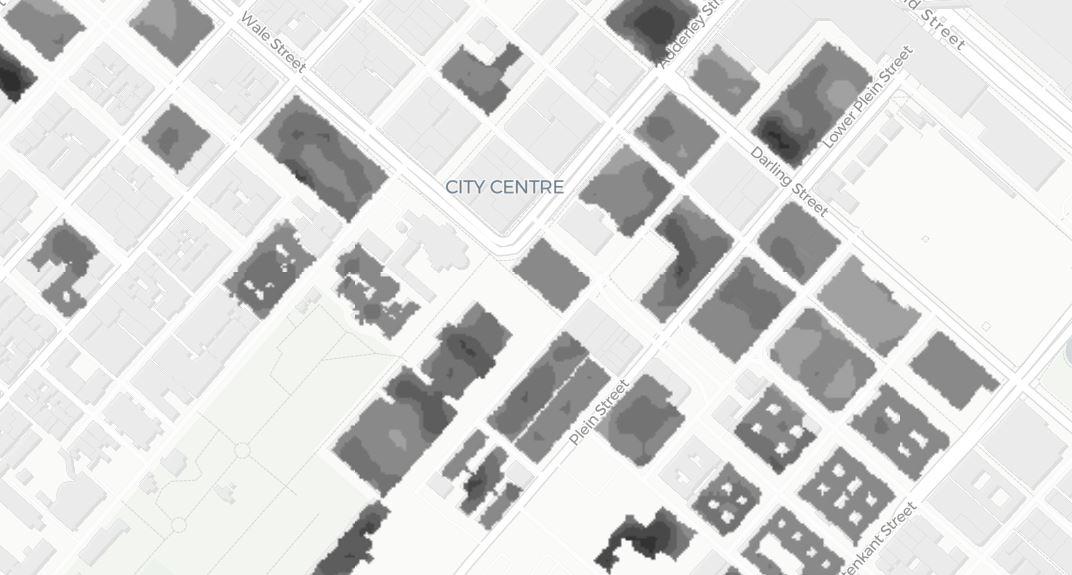
Image Preview

Surface reflectivity

Overview

This layer shows surface reflectivity, a measure of how much sunlight a surface reflects. Here, surface reflectivity is expressed as a value between 0 and 100%, representing the proportion of incoming solar radiation reflected by a surface. This same information is also common reported as albedo, a number beween 0 (for no light reflected) and 1 (for all light reflected). Light-colored surfaces have higher reflectivities, while darker surfaces absorb more heat and have lower reflectivities. The data are derived from Sentinel-2 satellite imagery using the methods of Bonafoni and Sekertekin (2020) for calculating albedo, which represents reflectivity on a scale of 0 to 1, and downscaled to a higher spatial resolution.

Function
To identify areas where low reflectivity might contribute to local heating.
Source
WRI
Data sources
Sentinel-2
Spatial resolution
10 meter
Spatial coverage
Global
Temporal resolution
Static
Temporal coverage
2017-present
Cautions
Albedo is estimated from satellite data which is affected by cloud cover, atmospheric conditions, and the angle and orientation of roofs. While we make every effort to minimize these effects, the data the data is not intended to serve as a tool for assessing the reflectivity of individual buildings. The data is suitable for guiding assessments of heat and the potential for creating interventions.
License
https://creativecommons.org/licenses/by/4.0/